
Aso Òkè
A textile civilization of Yoruba West Africa — cloth, power, and the making of cultural memory.
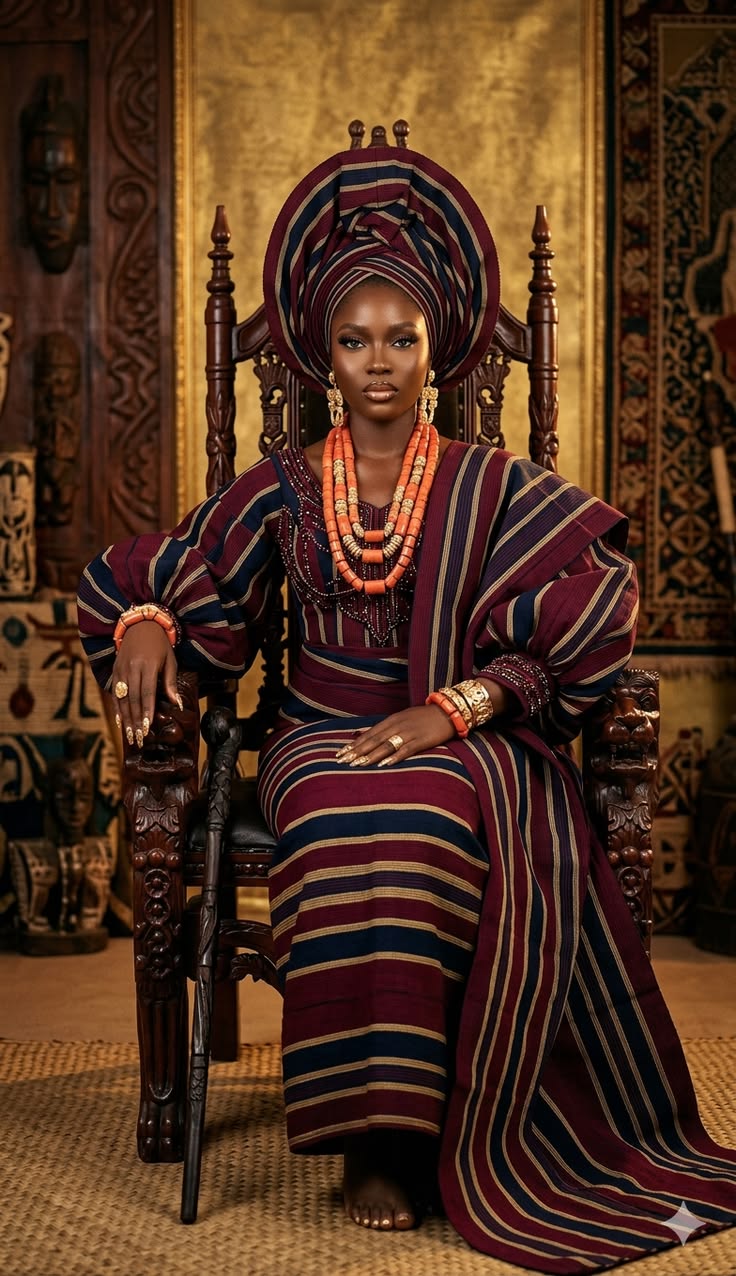
A Yoruba bride wearing a gele headtie made from contemporary Aso Òkè. Photo: Wikimedia Commons.
A handwoven strip-textile tradition of the Yoruba people of southwestern Nigeria, shaped by indigenous technological innovation, gendered labour organization, trans-Saharan trade networks, colonial economic disruption, and contemporary global fashion reinterpretation. Not a static artifact, but a living infrastructural system embedded in Yoruba ontology, political economy, and ceremonial life.
There is a cloth in Yoruba history that does not behave like cloth. It remembers. Aso Òkè is not simply worn at weddings or ceremonies in southwestern Nigeria. It is a textile system that has survived empires, trade routes, colonial disruption, and global fashion reinvention without losing its internal logic.
To the untrained eye, it is fabric. To Yoruba civilization, it is structure. It records identity without speech, organizes hierarchy without explanation, and carries memory across generations through thread. The cloth's very name speaks to this — Aṣọ òkè, meaning "top cloth" or "high-status cloth," signals not just prestige, but elevation: of person, of occasion, of meaning.
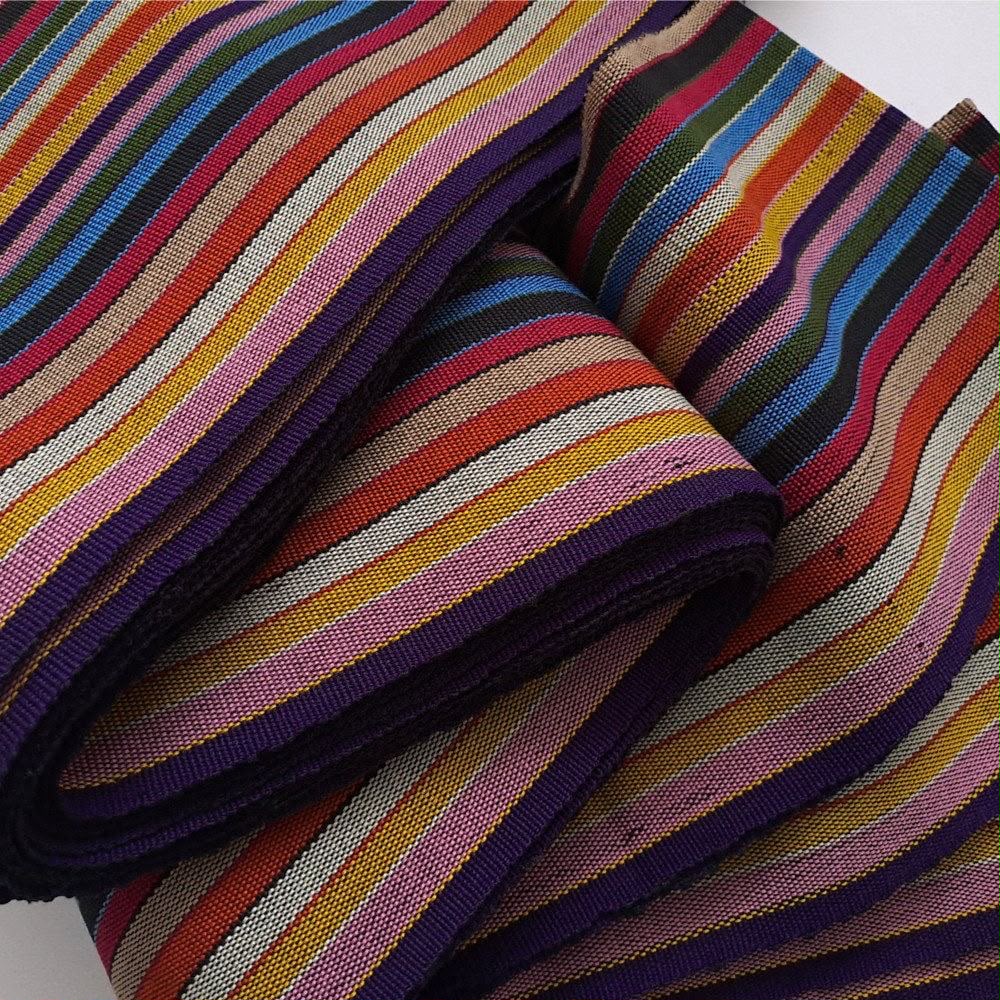
Aso Òkè narrow-strip woven textile, Yorubaland, Nigeria. Photo: Wikimedia Commons.
"To study Aso Òkè is not to study fashion history. It is to study how a civilization encoded memory into material form."
IHC Foundation · Material Heritage Series
The Living Palette of Aso Òkè
Aso Òkè is never monochrome. Indigo speaks of authority and restraint. Gold of celebration. Deep red and purple — the Alaari colours — of power and ceremony, imported via trans-Saharan trade from the 18th century onward. Sanyan beige of noble prestige, drawn from wild silk. Every thread carries a word the eye already knows how to read.
01 · Cloth in Yoruba Epistemology
In Yoruba thought, cloth is not external to identity — it participates in it. Dress communicates social status, moral character, lineage affiliation, and ritual positioning. Within this framework, Aso Òkè is not decoration. It is a system of social interpretation, a coded social language operating through pattern, colour, and construction rather than speech.
Scholars of West African material culture describe this role precisely: cloth in Yoruba ceremony is not worn but wielded. A wrapper of the wrong cloth at the wrong occasion is not merely a fashion error. It is a statement about who you are, where you stand, and what you know.


Left: Adire and Aso Òkè Yoruba textiles. Right: an artisan at the narrow-strip loom. Photos: Wikimedia Commons.
02 · The Three Classical Forms
Three principal categories form the entire material vocabulary of classical Aso Òkè. Each carries its own social weight, worn not by accident but by deliberate cultural intention. Together they constitute a visual grammar legible to every Yoruba community at a glance — a system of meaning older than any surviving written record of it.
Deep blue-black cotton with fine white stripe accents. The cloth of restraint, maturity, and authority — worn by chiefs and elders at the height of ceremony.
Woven from the wild silk of the Anaphe moth, left undyed. Pale brown-beige of prestige and quiet nobility — historically among the most costly to produce.
Woven from imported waste silk, dyed deep red or vibrant purple, arriving via trans-Saharan trade from the 18th century onward. The cloth of power and celebration.
03 · A Chronology of Civilization

Cotton cultivation, fibre spinning, dyeing, and weaving are already established in West Africa. Archaeological evidence of textile use among the Yoruba is reflected in sculptures dated to the 10th–12th centuries. Textile production is embedded in daily life, transmitted through apprenticeship and lineage across generations.
Trans-Saharan trade networks bring Yoruba regions into contact with wider West African systems, including Hausa city-states and Nupe regions. Cotton production intensifies. Indigo dyeing technologies deepen. Aso Òkè begins to emerge as a systematized textile economy rather than an isolated craft tradition.
The Oyo Empire — founded around the 13th to 14th century, at its political height from the late 16th to early 18th century — provides the framework within which Aso Òkè develops as a regional system. Cloth functions as both commodity and political language.
Industrial textiles from Britain, the Netherlands, and India disrupt everyday handwoven dominance. Mass-produced cloth floods West African markets. Aso Òkè survives by transitioning into ceremonial and identity-based usage rather than disappearing — a pivot that would, in the long run, ensure its survival.
Aso Ebi culture — rooted in pre-colonial Yoruba age-grade uniform dressing and growing rapidly from around the 1920s — transforms Aso Òkè into a coordinated social textile system and marker of group identity. Production continues in Iseyin, Ede, and surrounding weaving communities without interruption.

The Weaver at the Loom
Traditionally the domain of men, weaving was an apprenticed art passed through lineage structures across centuries of unbroken practice.
04 · Gendered Labour and Production
Aso Òkè production was organized through gendered specialization that mirrored the broader structure of Yoruba domestic life. Men built and operated the looms, weaving the narrow strips in workshops and compounds across the major producing towns. Women processed cotton, spun fibres, managed indigo dyeing, and — critically — controlled the textile trade networks through which finished cloth moved from weaving centres to urban markets.
This was not a division of inferior and superior labour. Each role was skilled, distinct, and indispensable. The cloth that arrived at a Yoruba ceremony was the product of an entire household economy working in coordinated, purposeful motion.
"It records identity without speech, organizes hierarchy without explanation, and carries memory across generations through thread."
05 · The Weaving Centres
Aso Òkè did not emerge from a single place. It was shaped by a network of specialist towns, each contributing a distinct voice to the larger textile ecology. These were not isolated craft villages but interconnected nodes in a living economic system, linked by trade routes, kinship networks, and a shared understanding of what the cloth meant.
The major weaving hub of Oyo State. The town has maintained unbroken continuity in strip-weaving traditions for centuries and remains the most active production centre today, sustaining thousands of weavers and their families.
Associated with royal and elite textile consumption. Ede was the centre of ceremonial cloth production for Yoruba political hierarchies, supplying the garments required for chieftaincy installations and court ceremony.
A cultural crossroads shaped by Yoruba, Nupe, and Hausa influences. Ilorin's textile vocabulary reflects Sahelian trade aesthetics and Islamic artistic sensibility, absorbed over centuries of exchange with northern networks.
A trade intermediary linking northern Yoruba regions to larger urban markets and the broader regional textile economy across the savannah and forest zones of southwestern Nigeria.
06 · From the Loom to the Runway
Once reserved exclusively for weddings, chieftaincy ceremonies, and the most significant moments of Yoruba life, Aso Òkè has in the 21st century made a decisive move onto the global stage — not as a curiosity, but as a material of serious creative and commercial weight.
The cloth has always adapted. It developed through contact with trans-Saharan trade networks from around the 11th century onward. It survived colonial economic disruption in the 20th. It entered global fashion in the 21st. At every turn, its internal logic held.
Aso Òkè on the International Stage
In February 2020, Nigerian designer Kenneth Ize brought Aso Òkè to Paris Fashion Week, where supermodel Naomi Campbell walked in his collection — merging Yoruba heritage with contemporary tailoring on one of the world's most scrutinized runways. The moment signalled a shift in how the global fashion industry understood African textiles: not as inspiration to be borrowed, but as the material itself, standing entirely on its own terms.
Nigerian designers Maki Oh, Lisa Folawiyo, and Deola Sagoe have brought Aso Òkè to international runways in varying forms. The fabric has expanded into luxury accessories — handbags and shoes exported to markets in France and Italy. Beyond the runway, Aso Òkè sustains over 50,000 artisans across production hubs including Iseyin, Oyo, and Ilorin, making it both a cultural and economic force of genuine scale.
In 2023, Aso Òkè exports grew by an estimated 15 per cent, generating approximately $120 million in foreign exchange revenue. The fabric is worn by Yoruba diaspora communities across the United States, United Kingdom, and Canada — where it remains, above all else, the cloth of ceremony, pride, and belonging.
This expansion is not a departure from the cloth's identity. It is a continuation of it. Aso Òkè has always been the fabric worn at the most important moments of Yoruba life. The global runway, it turns out, is simply another kind of ceremony.
Aso Òkè — history made material. Photo: Wikimedia Commons.
Aso Òkè as Civilizational Infrastructure
Aso Òkè integrates indigenous technological systems, gendered labour organization, political hierarchy, trade networks, spiritual symbolism, urban specialization, and cultural memory. Its continuity across centuries demonstrates adaptation, not preservation in isolation.
It survives because it remains embedded in living Yoruba social systems. The runway is new. The ceremony is ancient. The cloth connects them both without contradiction.
It is not simply cloth. It is history made material.
Bibliography
- Drewal, Henry John. "Textiles in West Africa." In Encyclopedia of African History and Culture, edited by Toyin Falola. New York: Facts On File, 2003.
- Kriger, Colleen E. Cloth in West African History. Washington: Smithsonian Institution Press, 2006.
- Kriger, Colleen E. "Unexpected Luxury: Wild Silk Textile Production among the Yoruba of Nigeria." Textile: The Journal of Cloth and Culture 7, no. 1 (2009).
- Law, Robin. The Oyo Empire, c.1600–c.1836. Oxford: Clarendon Press, 1977.
- Lovejoy, Paul E. Transformations in Slavery: A History of Slavery in Africa. Cambridge: Cambridge University Press, 2012.
- Picton, John, and John Mack. African Textiles: Looms, Weavers and Traditions. London: British Museum Press, 1995.
- Saint Louis Art Museum. Aso Oke: Prestige Cloth from Nigeria. Exhibition catalogue. St. Louis: SLAM, 2023.
- Business Day Nigeria. "Global Emergence of Nigeria's Aso-Oke: A Hidden Gem in Fashion Exports." September 2024.
Help preserve living textile traditions.
The Indigenous Heritage Conservation Foundation documents and supports the artisans keeping traditions like Aso Òkè alive, generation after generation.